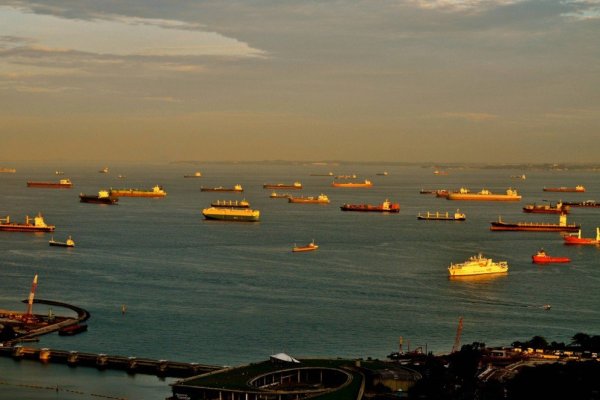
Oil prices on Friday were headed for a double-digit weekly drop, driven by the most unlikely of news headlines given the handwringing over the depletion of global inventories due to the U.S./Iran war: fresh signs of a global glut.
The news was delivered by JPMorgan, which in a report revealed that recovering Middle Eastern oil flows, rising production from other countries, and weak demand have pushed global supply above consumption.
The bank stated, “We estimate the global oil market returned to a surplus of 1.1 million barrels per day in September, widening to 1.4 million bpd in October, nearly matching last year’s average of 1.3 million bpd,” and it added that global crude imports in October rose above average 2025 levels, while demand lagged.
Global oil stocks did not fall in September or October, and global consumption declines reached 3.1 million bpd in September.
As for shipments from the Persian Gulf and despite heightened security risks around the Strait of Hormuz, ship-tracking firm Vortexa reported that crude and condensate exports from the Gulf averaged 14 million bpd in October, or about 86 percent of pre-war levels, while refined product exports averaged 3.1 million bpd, or just over half of normal volumes.
As of mid-session Friday, Brent traded at $97.55 per barrel, heading towards a 14-16 percent weekly drop; West Texas Intermediate traded around $89.17 per barrel, heading for a 13 percent weekly decline.
The other big driver of Friday’s trading was the deathless optimism among analysts of supposed renewed diplomatic engagement between the U.S. and Iran, by proxy, the evidence being Iran sending a nuclear proposal to Washington through Qatar.
However, that proposal appears to be no different than the seven conditions the Islamic republic initially demanded and many of which were rejected by Washington, including lifting the U.S. blockade against Iran, withdrawal of U.S. forces, war damage compensation, release of frozen assets, and a halt to U.S. threats and insults – in addition to no changes to the country’s nuclear ambitions.
Iran’s belligerence was magnified on Friday by Ali Akbar Velayati, an advisor to Iran’s supreme leader, who insisted that the transit corridors being developed by other Middle Eastern nations to bypass the Strait of Hormuz would be “too expensive or unstable” and bragged that ““The tsunami of geopolitical changes in West Asia has engulfed the elections in Israel and the United States; the result: Iran is now one of the principal architects of the regional order, a reality that can neither be eliminated nor replaced.”
Still, Qatar said Friday that U.S. president Doanld Trump called its leader Sheikh Tamim bin Hamad Al-Thani to discuss "the ongoing diplomatic efforts aimed at de-escalating tensions in the region."
For his part, Bob McNally, Rapidan Energy Group founder and president, told media that he saw an 80 percent probability of military fighting resuming, which he believed could cause both Brent and WTI to climb above $100 per barrel.
McNally said, “Trump is determined, as a legacy item, almost at all costs, to prevent Iran from getting a nuclear weapon, having them give up their nuclear capabilities; the Iranian regime, on the other hand, is not willing to do it, and as long as that core difference in that deal space is absent, the escalation dynamic remains in place.”