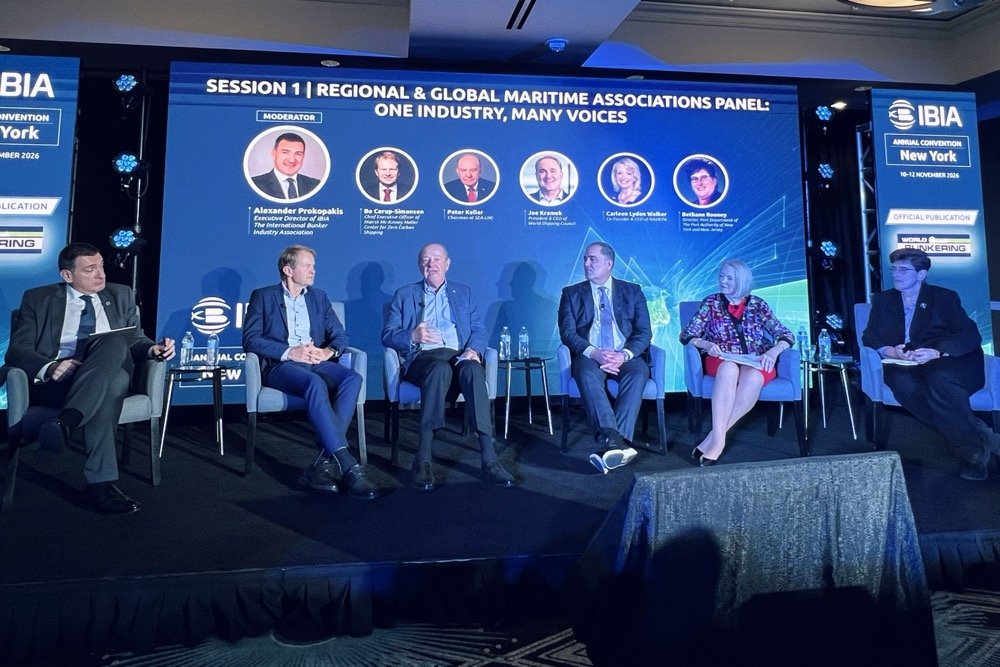
Whatever the outcome of the latest discussions on the IMO's Net-Zero Framework (NZF), Shipping will adapt, the IBIA Annual Convention's Regional & Global Maritime Associations Panel in New York heard last week.
With global regulation currently in limbo, consensus at the IMO on a workable framework is widely expected to be the long-awaited signal that triggers a new wave of investment in alternatively fuelled ships and associated bunkering infrastructure.
Many fear that without a global framework a patchwork of regional regulations will emerge, adding significant complexity and cost for global operators.
Indeed, regional regulations such as the EU Emissions Trading System (EU ETS) and FuelEU Maritime have already begun, and delegates were told the EU is unlikely to give up the ETS, so that patchwork is likely to remain even if a deal is reached at the IMO.
"What government do we know anywhere in the world is prepared to give up tax revenue?" said Peter Keller, Chairman of SEA-LNG.
EU politicians have said they will consider adjustments to their schemes based on what steps the IMO takes, the panel heard, but because ETS revenue goes to member states it was viewed as being something that would be very difficult to claw back.
Others including the UK and Turkey are looking at their own measures, the panel heard, and there is also an African carbon coalition.
For an average shipowner with six to 10 ships, the administrative work of the EU ETS alone is already exceedingly complex, the panel heard, "so imagine trying to do it globally."
The panel was moderated by Alexander Prokopakis, Executive Director of IBIA, with Bo Cerup-Simonsen, CEO of the Mærsk Mc-Kinney Møller Center for Zero Carbon Shipping; Peter Keller, Chairman of SEA-LNG; Joe Kramek, President & CEO of the World Shipping Council; Carleen Lyden Walker, Co-Founder & CEO of NAMEPA; and Bethann Rooney, Director, Port Department, Port Authority of New York and New Jersey.
Other key points from the session, which was held under the Chatham House rule, are reported below without attribution to any individual speaker:
Global Rules
- The industry needs a global standard.
- Concerns about the cost of a carbon framework need perspective: shipping a pair of sneakers costs about seven cents, and the framework would add "one penny".
- About $200 billion has already gone into dual-fuel newbuild orders, most of them starting with LNG.
- People need to think in terms of "rules, tools, and fuels": the rules from the IMO, the dual-fuel ships as the tools, and the fuels made available at the ports where they are needed.
- The industry is able and willing to invest, and can afford to, if a strong regulatory framework with absolute targets sends a clear demand signal.
- Shipping's total emissions fell by about 20% from 2008, but have risen by about 20% in recent years as bottlenecks pushed up ton-miles.
- The 2030 targets look hard to reach, making 2035 and 2040 more useful milestones to discuss.
Ports and Bunkering
- Of about 6,000 deep-draft vessels calling at New York and New Jersey each year, just four could burn an alternative fuel in 2024, a number expected to reach 45 by the end of this year.
- None of those vessels can lift alternative fuel in New York, where state rules in both New York and New Jersey prevent vessel-to-vessel transfers of LNG.
- Alternative-fuel bunkering in New York is stuck with the chicken and egg problem: companies are willing to supply, but there is not yet enough demand to justify the investment.
- The Port Authority would consider hosting bunkering facilities if the container lines named one or two fuels they plan to standardise on.
- The boards of Los Angeles and Long Beach announced that they will start working with CARB on bringing alternative fuels to the ports, where LNG bunkers currently arrive by bunker vessel from Vancouver.
- Bunkering does not always need major investment to start: truck-to-ship skids linking four trailers can deliver 25 trailer loads in five or six hours.
- Community safety concerns about new fuels have to be worked on in parallel with, or ahead of, international regulation.
Fuels
- There will be a basket of fuels, shaped by safety, availability, affordability, scalability, and energy density.
- Energy density will be a key factor in which fuels succeed: "Do shipowners want to carry fuel, or do they want to carry revenue?"
- For now LNG is doing well thanks to supply chains, pricing, and availability at most major ports.
Safety and Crew
- IMO safety regulations for new fuels are not expected before 2028, and for hydrogen not until 2032.
- The hardest part of training crews is getting sea time, because there are still few new-fuel ships in service.
- Crews on new-fuel vessels, including ammonia, say they are comfortable running them with the proper training and ship design.