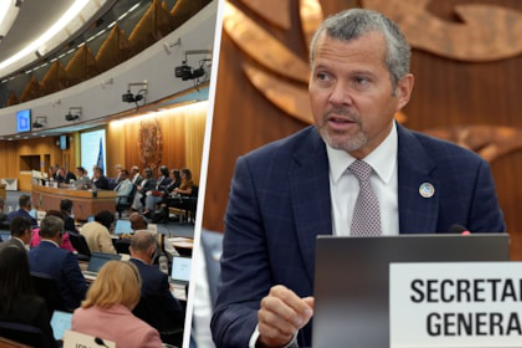
- Dominguez tells cargoes sub-committee to stop attacks on merchant ships and seafarers
- 80 verified attacks around Hormuz since February 28, at least 22 seafarers killed
- Dozens of deaths reported in Black Sea and Sea of Azov; four killed in August 11 Houthi attack
- Member states urged to take shipping impacts to their capitals and the UN
IMO Secretary-General Arsenio Dominguez has called on member states to stop attacking merchant ships and putting seafarers' lives at risk in the conflicts in the Middle East, the Black Sea, and the Red Sea.
Addressing the IMO's Sub-Committee on Carriage of Cargoes and Containers, meeting in London from September 14 to 18, Dominguez warned of the severe impact of geopolitical tensions on the industry, the IMO said in a statement on Wednesday.
"We are reaching a point where these conflicts are being used as a pretext to attack merchant vessels and innocent seafarers," he said.
"Do not use these conflicts to attack innocent seafarers."
Since the current conflict in the Middle East began on February 28, the IMO has verified 80 attacks on international shipping in and around the Strait of Hormuz, killing at least 22 seafarers and injuring many more.
In the Black Sea and Sea of Azov, dozens of deaths have reportedly resulted from attacks on shipping in recent months, though the IMO says precise numbers are difficult to verify.
Attacks in the Red Sea have also resumed, with four deaths confirmed in the latest Houthi attack on a merchant vessel on August 11.
"In the Strait of Hormuz, it is not only one country attacking merchant vessels. In the Black Sea and Sea of Azov, it is not only one country attacking merchant vessels," Dominguez said.
Addressing the root causes of the conflicts is beyond the IMO's remit, he said, but their impact is increasingly evident across global maritime trade, and he urged delegates to raise it with their governments and in the relevant international bodies, with the IMO secretariat ready to contribute workable solutions at the technical and operational level.
"I call on you to share these impacts with the relevant bodies in your countries so that this can be dealt with within the United Nations, as appropriate," he said.
"It falls to you and your capitals, and relevant bodies of the United Nations, to address the root causes and find solutions."