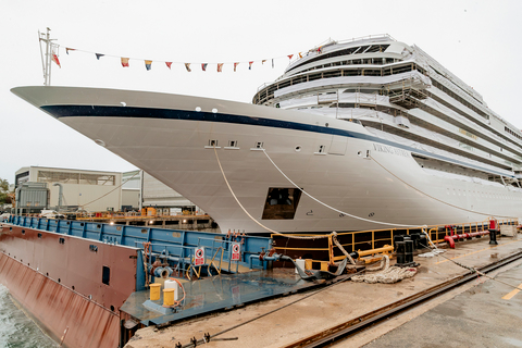
- Viking Astrea floated out at Fincantieri's Ancona shipyard, moving into final construction
- Delivery scheduled for May 2027, with a first season in the Mediterranean and Northern Europe
- Hybrid propulsion based partly on liquefied hydrogen and fuel cells, rated at up to six megawatts
- Sister ship Viking Libra, billed as the world's first hydrogen-powered cruise ship, is due in November 2026
Viking has announced the float-out of the Viking Astrea, its second hydrogen-powered cruise ship, at Fincantieri's Ancona shipyard in Italy.
The 998-guest vessel is scheduled for delivery in May 2027 and will spend her first season sailing in the Mediterranean and Northern Europe, the cruise line said in a press release on Friday.
After a two-day process to set the ship afloat she will move to a nearby outfitting dock for final construction and interior fit-out.
The Viking Astrea has a gross tonnage of around 54,300 and 499 staterooms, and will carry a hybrid propulsion system based partly on liquefied hydrogen and fuel cells.
Viking says the system, supplied by Fincantieri's fuel cell subsidiary Isotta Fraschini Motori, will be capable of producing up to six megawatts of power and will allow the ship to navigate and operate with zero emissions, giving it access to environmentally sensitive areas.
"From the beginning, we have sought thoughtful ways to design more efficient ships, and the Viking Astrea is an important step forward in that ongoing effort," said Leah Talactac, president and chief executive officer of Viking.
Sister ship the Viking Libra, which Viking describes as the world's first hydrogen-powered cruise ship capable of zero-emission operation, is scheduled for delivery in November 2026.
Where Hydrogen Fits
Hydrogen used directly as a ship fuel remains a niche within the alternative fuels picture, and the Viking pair are among very few large ships being built to burn it.
DNV's Alternative Fuels Insight platform recorded a single hydrogen-fuelled order in the first five months of this year, with two hydrogen-powered bulk carriers added in August, against 242 alternative-fuelled vessels ordered in the year to August, 63% of them LNG.
In its Maritime Forecast to 2050, the class society says hydrogen's own role in shipping has narrowed, because its low volumetric energy density makes it hard to store in the quantities a deep-sea ship needs, while fuels made from hydrogen, chiefly methanol in the near term and ammonia later, could account for around half of the fuel mix by 2050.
That points direct hydrogen use towards ships where zero-emission operation matters more than range, which is the case Viking makes for the two cruise ships, and towards fuel cells sized for auxiliary and hotel loads, the scale at which Yanmar's hydrogen fuel cell system, type-approved by DNV at SMM last week, operates.