-
Clarksons Research puts 2026 bunker spend at a record $220 billion
- Bunker market estimated at 290 million tonnes
- Ton-miles a better guide to bunker demand than cargo volumes
- Alternative fuels seen rising from 10% to over a third of fleet tonnage within 10 years
- 2,000 newbuilds to have scrubbers fitted
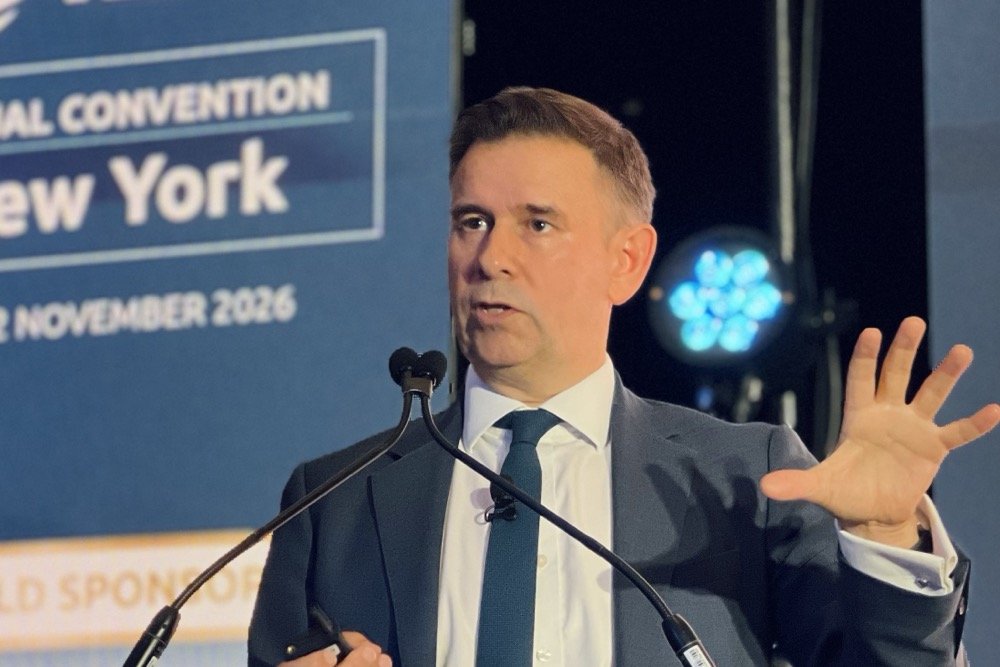
Shipping is set to spend a record $220 billion on fuel this year, Clarksons Research Managing Director Steve Gordon told the IBIA Annual Convention in New York on Wednesday as part of a data-packed Keynote Market Presentation on The State of the Industry.
Clarksons estimates the size of the bunker market at 290 million tonnes, though Gordon said that number depends a great deal on where the line is drawn on the smallest ships.
In recent times global bunker consumption was falling as ships slowed down because of surplus capacity, but it has now started to grow a little again, he said, even though ships entering the market today are around 50% more fuel efficient than those built 15 years ago.
Gordon said ton-mile projections are probably a better guide to overall bunker consumption than the total volume of trade, with this year's disruption to energy exports out of the Gulf a case in point, where there has been a slight fall in trade volumes, but ton-miles are expected to grow by about 1-1.5%, he said.
Overall, distances are up 10% this decade.
Disruption
Despite the well-documented disruption to oil flows as a result of the Middle East conflict, Gordon said more than 90% of normal Middle East crude exports are still reaching market, at 16-17 million b/d against an average 18 million b/d last year, albeit through what he called "a completely different logistical framework".
That includes ship-to-ship shuttling out of the Gulf, and oil loaded at Yanbu, piped through the SUMED pipeline, and reloaded in the Mediterranean for the voyage round Africa to Asia.
VLCC earnings have surged as a result, averaging as much as $800,000/day, against $50,000/day last year, although rates have since softened and are now around $350,000-400,000/day, he said.
The conflict has also seen 150 ships attacked in the region this year.
"The reason we haven't had $250 a barrel of oil, in my view, is because we've had the operational flexibility to get oil to market," he said.
A fall of about 3 million b/d in Chinese oil demand has been another big factor, he added.
For the bunker industry, he said the themes of the year have been the spreads between Rotterdam and Singapore, exceptionally high prices, availability, security, and volatility.
Fleet
Gordon said Shipping is in its most profitable period ever, with the ClarkSea Index at $46,000/day in the last quarter.
Much of that cash is going into a record orderbook of about 10,000 ships worth around $800 billion.
The result in tonnage terms is that fleet growth will be 5% this year and 6% in 2027.
At the same time the global fleet is ageing, with little demolition while markets have been strong.
He also reminded suppliers how fragmented their customer base is.
"The average shipping company has only five ships," he said.
"So if you're thinking about your sales and marketing strategy, try and keep it flexible."
Fuels
While the political consensus on regulation has stalled at IMO level, Gordon said investment in alternative fuels continues, but varies significantly by sector.
Big container ships and car carriers are likely to be ordered as dual-fuel LNG, he said, while tankers, bulkers, and other ships will run on conventional oil bunkers, packed with energy-saving technology such as Flettner rotors and air bubble lubrication.
About 10% of the world fleet by tonnage can run on alternative fuels, much of it gas carriers using their own cargo, and Clarksons expects that to reach 17% by the end of the decade and more than a third within 10 years.
There are 1,700 LNG-fuelled ships in service and 1,200 on order, he said, with 60 LNG bunker tankers in operation and another 50 due over the next three to four years.
Of the ports Clarksons tracks, about 40 are planning ammonia bunkering, but only four offer it today.
Scrubbers remain an important part of the market, with 2,000 newbuilds set to have one fitted and around 300 retrofits a year still taking place, he said.
Looking further ahead, Gordon said geopolitics has created a new normal for Shipping.
"It means that we need more tonnage per volume of cargo moved in the future than we did in the past," he said.
But he warned that a larger orderbook leaves Shipping more exposed if the world economy weakens.
IBIA's 2026 Annual Convention takes place today and tomorrow, where more than 275 delegates have gathered at the New York Marriott Downtown in Manhattan.