- Ship & Bunker raises G20-VLSFO Q4 forecast to $882/mt, from $758/mt in last month's outlook; second rise of more than $100/mt in as many months
- EIA lifts Q4 2026 Brent forecast to $104.69/bbl, up $14.03/bbl from September
- Full-year 2026 Brent forecast rises to $96.32/bbl from $91.01/bbl; 2027 to $83.74/bbl from $73.74/bbl
- Brent averaged $114/bbl in September after attacks on oil infrastructure and tankers around the Middle East
- Current G20-VLSFO price stands at $876.50/mt; Singapore $890/mt, Rotterdam $682.50/mt
Ship & Bunker has raised its Q4 bunker price outlook by more than $100/mt for the second month in a row after the US Energy Information Administration (EIA) lifted its Q4 Brent crude forecast above $100/bbl in the October Short-Term Energy Outlook (STEO), published on Tuesday.
EIA now forecasts Brent to average $104.69/bbl in Q4 2026, up from $90.66/bbl in last month's outlook.
For the full year, EIA sees Brent averaging $96.32/bbl in 2026, up $5.31/bbl from the September STEO forecast of $91.01/bbl.
The agency has added exactly $10/bbl to each quarter of 2027, taking Q1 to $94.90/bbl, Q2 to $87.00/bbl, Q3 to $80.03/bbl, and Q4 to $73.94/bbl, and lifting the 2027 full-year forecast to $83.74/bbl from $73.74/bbl.
Brent averaged $95.95/bbl in Q3 2026, above the $89.11/bbl EIA had forecast for the quarter last month.
Prices rose to an average of $114/bbl in September, $23/bbl higher than in August, following increased attacks on oil infrastructure and tankers around the Middle East, the most notable being on Saudi Arabia's East-West pipeline, which temporarily halted flows on a crucial bypass around the Strait of Hormuz, EIA said.
Before the attacks the pipeline was carrying more than 5.0 million b/d of exports via Yanbu on the Red Sea, EIA estimates, and the loss of those barrels sent daily Brent to as high as $131/bbl on September 15 as buyers scrambled for near-term supply.
Daily prices eased somewhat in the last week of September as repairs allowed partial flows to resume as of September 22, EIA said.
Some of the lost Red Sea exports have been offset by shifting exports back through Hormuz, and Vortexa ship tracking data cited by EIA shows shipments through the strait rose slightly in September as Saudi Arabia made more use of ship-to-ship transfers along Oman's coast.
The agency estimates closure-related shut-ins fell to 4.8 million b/d in September, the lowest since the conflict began, down from 5.8 million b/d in August and 10.9 million b/d at the peak in May.
It assumes flows from the region stay constrained through Q4, with shut-ins averaging 4.5 million b/d, before falling to 2.7 million b/d in Q1 2027.
"The attacks on the East-West pipeline in Saudi Arabia highlight the potential for continued volatility in physical oil flows and oil prices amid ongoing withdrawals of oil inventories globally," EIA said in the report.
"Additional upward pressure on crude oil prices stems from extreme tightness in diesel markets that raises demand for crude oil in order for refiners to meet diesel demand."
EIA also points to tanker rates, which it says reached record levels in September as insurance costs rose, adding to delivered crude costs for refiners, while longer routes around conflict zones are limiting the number of vessels available.
Global oil inventories fell by an estimated 1.9 million b/d in Q3, and EIA expects a further draw of 0.7 million b/d in Q4.
The agency still expects most production in the region to return to pre-conflict levels by the end of Q2 2027, helped by bypass routes, ship-to-ship transfers, and new pipeline capacity in the UAE due next year, and says it expects prices to fall generally from their early October average.
The forecast includes the 40 million barrel exchange from the US Strategic Petroleum Reserve announced on September 29, but not any additional supply resulting from the G7's announcement on October 2, EIA said.
Bunker Price Implications
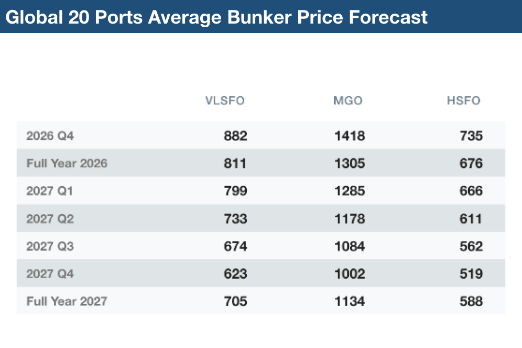
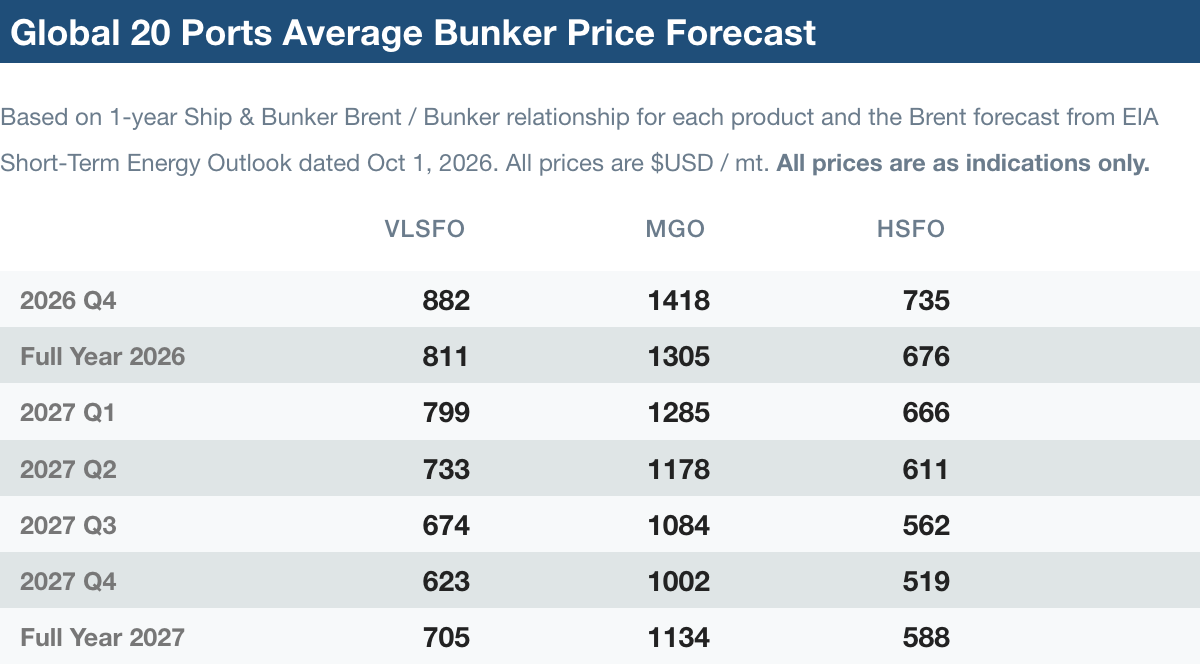
Based on EIA's updated crude outlook, Ship & Bunker now forecasts VLSFO prices at primary bunkering ports, as tracked by the G20-VLSFO Index, to average $882/mt in Q4 2026, up from $758/mt in last month's outlook, and $236/mt above the $646/mt forecast in the August outlook.
For the full year, the revised EIA forecast implies a G20-VLSFO average of $811/mt in 2026 and $705/mt in 2027, compared with $761/mt and $617/mt in the September outlook.
The G20-HSFO Index is now forecast to average $735/mt in Q4 and $676/mt for full year 2026, up from $634/mt and $636/mt respectively last month, while the G20-MGO Index is forecast at $1,418/mt in Q4 and $1,305/mt for the full year, up from $1,203/mt and $1,208/mt.
Current G20-VLSFO prices stand at $876.50/mt, with VLSFO prices at $890/mt in Singapore and $682.50/mt in Rotterdam.
In Singapore, the world's largest marine fuel hub by volume, Ship & Bunker forecasts VLSFO to average $842/mt in Q4, $775/mt for full year 2026, and $674/mt for 2027, up from $720/mt, $723/mt, and $586/mt respectively in the September outlook.
At Rotterdam, the Q4 VLSFO forecast is $743/mt, with $683/mt for full year 2026 and $594/mt for 2027, compared with $643/mt, $645/mt, and $523/mt last month.
Ship & Bunker publishes bunker price forecasts for every port and index it covers, based on the Brent forecasts from the monthly EIA STEO.
The forecasts are based on the average price relationship between each fuel and Brent over the previous 12 months.