- Price weakness sets the tone for 2026
- Margins face mounting headwinds - Regulatory Knock-On Costs, Growing Credit and Counterparty Risk, Trade Disruption and Increased Competition
- Conventional bunker demand to flatline over the coming years
- Have your say: Head to the poll on our LinkedIn page to vote for what you think will have the biggest impact on margins this year
Bunker fuel markets have begun 2026 facing a challenging mix of low prices, soft demand and rising regulatory pressure, leaving margins increasingly exposed.
Bunker prices are forecast to remain subdued through 2026 and into 2027, with the latest analysis by Ship & Bunker, showing average VLSFO prices are expected to slip into the low $440s/mt in the coming months and remain below $450/mt until at least the end of next year.
The forecast points to a potential low of around $417/mt in early 2027 - levels not seen since 2020.
The persistence of lower bunker prices reflects broader oil market dynamics.
Increased crude production from OPEC+ members, combined with weak oil demand growth amid fragile global economic conditions, has continued to weigh on prices across the refined products complex.
According to a recent report from the International Energy Agency (IEA), global oil supply is expected to rise by around 2.5 million b/d in 2026 to average 108.7 million b/d. This suggests that the market is expected to be well supplied.
While lower bunker prices offer some relief to shipowners, they are proving far less supportive for suppliers. With prices expected to remain under pressure, bunker suppliers may struggle to protect margins in a market characterised by intense competition and limited scope to pass on rising operating costs.
Weakening Margins Amid Sluggish Volume Growth
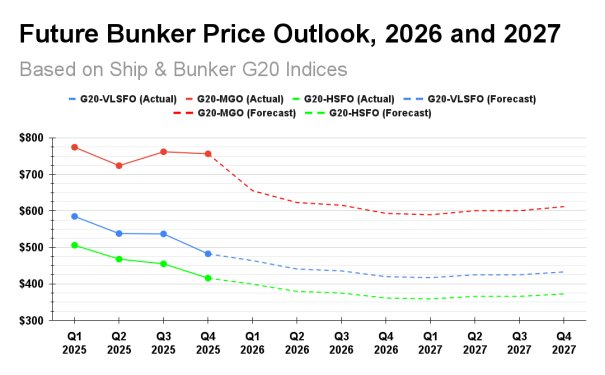
Image Credit: Ship & Bunker
Margin pressure is being compounded by slow growth in bunker demand.
The latest quarterly bunker volumes survey published by Ship & Bunker and 2050 Marine Energy showed global bunker volumes on track for a 1.9% increase last year based on the first three quarters of data. Even so, total volumes remain below the levels recorded in 2019, before the COVID-19 pandemic disrupted global trade and shipping patterns.
Longer-term demand signals are also subdued.
The IEA has warned that global bunker fuel demand is expected to flatline at around 5 million b/d through to 2030, as emissions regulations, efficiency gains and weak trade growth weigh on consumption.
Delegates at the IBIA Annual Convention in Hong Kong last year also reiterated that conventional bunker demand is expected to be flat over the coming years.
For bunker suppliers, this implies limited volume-led upside.
Daniel Rose, CEO of Shipergy, told Ship & Bunker in a recent interview that the firm is deploying AI tools to avoid increasing staff as part of a commercial reorganisation geared at addressing the current market downturn.
"I've been in this business for a very long time, and I've never seen it being this bad for this long," he said.
Regulatory Knock-On Costs
At the same time, suppliers are grappling with rising regulatory and compliance-related costs.
The expanding reach of emissions regulation, particularly in Europe, is adding complexity and cost to conventional bunker supply chains.
While lower VLSFO prices may soften the impact of these measures for ship operators, the cost burden for suppliers, from administrative overheads to risk management and financing, continues to rise.
In practice, this means bunker sellers are being squeezed from both sides: falling or stagnant prices on the revenue line, and structurally higher costs below it.
For smaller and mid-sized suppliers in particular, the margin for error is narrowing.
Growing Credit and Counterparty Risk
Persistently low prices and weak margins can also increase both credit and counterparty risk across the bunker market.
Bunker suppliers typically extend credit to shipowners, operators and traders, with fuel delivered well before payment is received. In a low-margin environment, this could leave suppliers more exposed to late payments or defaults
Sanctions-related compliance has also emerged as an additional risk factor.
A trader in the MEA region this week, who asked not to be named, told Ship & Bunker that suppliers and traders are being increasingly cautious when entering into new deals as sanctions regimes continue to evolve.
This potentially limits their ability to pursue new business and adds further pressure in an already weak market.
Increased Competition in Key Ports
Low bunker prices and sluggish demand also means an increasingly competitive market environment, particularly in key ports.
Suppliers are being forced to sharpen pricing, optimise logistics and focus on operational efficiency to defend market share.
At the same time, the market is seeing the entry of new bunker trading firms, adding further competition.
Some are seeking to diversify revenue streams through alternative fuels and biofuel blends, though volumes in these segments remain relatively limited compared with conventional oil-based bunkers.
A representative from a global bunker firm said during the IBIA Annual Convention that biofuel demand had been lower than expected, largely because of higher prices.
Trade Disruption & Shifting Fuel Demand Patterns
Tariffs have added another layer of uncertainty for shipping markets, compounding the impact of broader geopolitical tensions.
At the same time, some of the demand uplift seen in recent years is beginning to reverse as conditions in the Red Sea improve.
With security risks easing, major shipping companies, including AP Moller Maersk and Hapag-Lloyd, are gradually returning vessels to Suez Canal transits rather than routing them around the Cape of Good Hope.
The shift back to shorter voyages is reducing fuel consumption per trip, eroding part of the additional bunker demand that was created during the period of widespread diversions.
At the same time, HSFO demand from scrubber-fitted ships is increasing. This has prompted some suppliers to introduce HSFO or adjust barge allocations to ensure product availability.
Singapore, the world's largest bunker hub, saw HSFO sales rise by 7.8% on the year in 2025, while VLSFO sales fell by 2.5%. HSFO accounted for 38.7% of the total bunker sales in 2025, up from 37% in 2024.
Unless oil market fundamentals tighten materially or bunker demand growth surprises to the upside, margins are likely to remain under strain through the year ahead.
Have your say: Head to the poll on our LinkedIn page to vote for what you think will have the biggest impact on margins this year.